
Warm-up strokes first
Long Swedish strokes bring circulation to the area and warm the tissue, so the deeper work that follows meets muscle that’s ready for it.
A therapeutic massage has a goal. Your therapist works the shoulder, neck or back that's bothering you, toward relief you'll notice when you move. We're on St. Albert Trail in north Edmonton.
$126.00 / 60 Minutes (+GST)

When one spot won't settle
It's one shoulder, or one side of your neck, or the same spot low in your back. You roll it. You stretch it. The tension and stiffness are back by lunch.
Say you’ve strained your rotator cuff. The pain sits in your shoulder, but the muscles that move it run up into your neck, across your upper back and down your arm. A therapeutic massage works on all of them, because that’s where the shoulder gets its help.

Perhaps you’ve had massages that spent the hour everywhere except the spot you came in for. One client, seven years on from a car accident, wrote about how hard it is to find someone who gets the right spots. Here the session starts with what hurts, and it stays there.
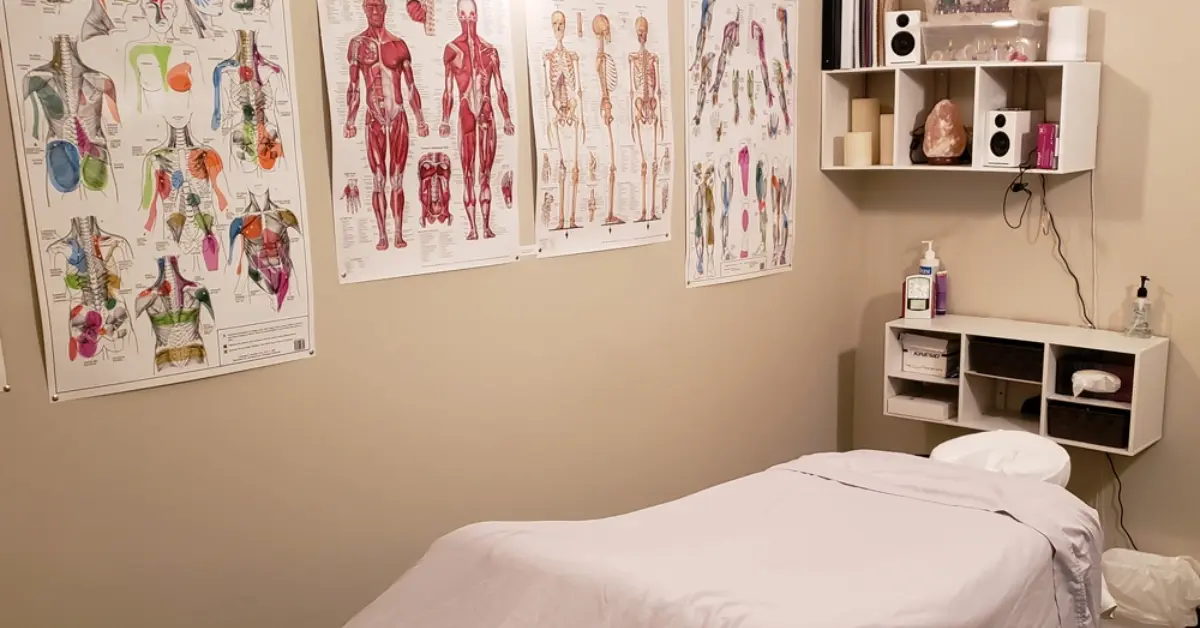
Therapeutic massage is a focused massage with a goal in mind, sometimes called remedial massage. Your registered massage therapist works on the pain and discomfort left by an injury or an imbalance in the body, concentrating on one area and the structures connected to it rather than spreading the hour evenly.
Long Swedish strokes bring circulation to the area and warm the tissue, so the deeper work that follows meets muscle that’s ready for it.
Slow pressure from deep tissue massage and held pressure from trigger point therapy go where the tension sits. The aim is pain relief in the place you pointed to.
Myofascial release frees the connective tissue around a muscle, and PNF stretching pairs massage with stretching. Fascial Stretch Therapy, where your therapist moves you through each stretch, is offered too. Together they help bring back range of motion and flexibility.
Warmth helps a tight muscle let go. If you’d like heat as part of the work, ask about hot stone massage.
Therapeutic massage suits conditions with a clear home in the body: a painful back or neck, a joint that has lost movement, or an injury that has healed but still hurts. Your therapist asks what's going on first, and works around anything your doctor has told you to protect.
Each linked page carries the research for that condition.
A therapeutic massage aims at one problem area and uses whatever techniques that area needs. Deep tissue massage works on general tension across the whole body, with slow, firm pressure into the deeper layers. A relaxation massage aims at neither.
| Therapeutic Massage | Deep tissue massage | |
|---|---|---|
| Goal | Relief for one problem area | Less tension through the whole body |
| Where the work goes | The problem area and the structures connected to it | Usually the full body, slowing down where tension has built |
| Pressure | Whatever the area needs, from gentle to firm | Slow and firm, in the 4 to 6 range on a 10-point scale |
| Techniques | Swedish, deep tissue, trigger point, myofascial release, PNF stretching | Slow strokes and sustained pressure into the deep layers |
| Suits | A strain, an old injury, one spot that keeps hurting | Tension built up from desk work, stress or training |
| At Got Knots | Same rates, direct billing | Same rates, direct billing |
If one spot is the reason you’re booking, book therapeutic massage. If the tension is everywhere, deep tissue massage is the better fit.
Every muscle in your body sits inside a thin wrap of connective tissue called fascia. Johns Hopkins Medicine describes it as “a thin casing of connective tissue that surrounds and holds every organ, blood vessel, bone, nerve fiber and muscle in place,” and adds, “When stressed, it tightens up.”
The fascia around a muscle is called myofascia. You’ve seen it. It’s the white, web-like layer on a cut of meat.
Healthy fascia slides. It thickens and gums down for a few ordinary reasons:
When that happens the muscle underneath loses its glide. You feel it as a stiffness no stretch seems to reach, or a spot that aches after you’ve been still too long and eases once you’re moving again.
Your therapist usually works without oil, because they need to hold the skin rather than slide over it. The movement is slow. It often looks as if they’re stuck in one place for a long time.
They aren’t. They’re waiting for the tissue to give.
Some people feel a burning or pinching sensation that eases as it does. Myofascial release is a treatment on its own, and it also turns up inside a therapeutic, deep tissue, prenatal or sports massage, almost always on one focused area.
Myofascial release is one tool. The benefits of therapeutic massage come from putting the right tools on one problem.
For chronic low back pain, studies of myofascial release found less pain and better function.
Take a sore lower back. Your therapist warms the area with long strokes, works the tight bands with slow pressure, releases the fascia that has gummed down across the hips and finishes with stretching. By the end of the hour, the muscles around your back have had as much attention as the spot that hurts.
It’s the massage to book when you know exactly where it hurts.
Thirty, sixty and ninety minutes all book online, and you can pick a therapist by name or select all of them to see every opening the clinic has that week.
Pressure and focus start from what you tell us rather than a routine, and your therapist says what they are finding while they work. You hear it as it happens.
Before you leave, we can put your next appointment on the calendar, and our own booking page will tell you the current week may already be full.
Come a few minutes early your first time, because there is a short health history to fill out, and filling it in the waiting room spends the hour you booked on paperwork instead of treatment on the table.
You know what the hour will involve, what it costs, and when you are coming back.
I started going to Got Knots Massage for about 2 years for chronic pain in my lower back. Wouldn't go anywhere else. Highly recommended.
Nadine is excellent and worked wonders for my shoulder and neck! Got knots is cozy, welcoming and professional. Highly recommend!
going to this company for over 10 years
Most importantly they listen to my massage needs
Wouldn't go anywhere else
By far the best
my pain reduced almost 70%
I haven't seen anyone else since
found muscles I didn’t even know existed
the best I’ve had yet
I have been seeing Nadine for 20 years
Clinic-wide membership with the Natural Health Practitioners of Canada means the receipt you hand your insurer is the same document whichever therapist you book, and the hour you get is held to the same standard.
It is a discount you buy once and spend as the sessions come, instead of a monthly fee you have to remember to cancel.
Eleven years with no lapse and no downgrade, on a rating anyone can check.
Most people book 60 minutes, which is $126.00 plus GST. Thirty minutes is enough for one small area, like a wrist or one side of your neck. An hour gives your therapist time for the problem and the structures around it, and that time is most of what makes the massage therapeutic.
| Massage length | Price |
|---|---|
| 30 minutes | $84.00 |
| 60 minutes | $126.00 |
| 90 minutes | $168.00 |
We bill your extended health provider directly, so you only pay the part your plan doesn't cover, and the card we keep on file isn't charged until your insurer has paid its share. We can bill your primary plan only. If your plan needs a doctor's referral for massage, send it to your benefit provider before your appointment, not to us.
Alberta Blue Cross – Sun Life – Canada Life – Telus Health (Manulife, Canada Life + 20 more) – Medavie (incl. Veterans Affairs & RCMP) – Green Shield
Nadine Munro has been a Registered Massage Therapist since 2000 and founded Got Knots in 2009. Every therapist on our team is an RMT with at least 2,200 hours of training, and together we've treated more than 4,300 clients since the clinic opened.

FocusDeep tissue, cupping and children's massage
A therapeutic massage spends the hour on one area that hurts, while a regular massage spreads it across your whole body to ease general tension or help you relax. For how it differs from deep tissue, see the therapeutic vs deep tissue comparison.
It starts with a conversation about where it hurts, what makes it worse, and anything your doctor has told you. Then your therapist works on that area with the techniques it needs, warming it first, working deeper as it allows and stretching what has loosened, checking the pressure with you as they go. You leave with one or two things to do at home.
Usually, yes. Plans that cover massage by a registered massage therapist cover therapeutic massage therapy too, because it’s booked as a massage appointment. We handle direct billing wherever your plan allows it, so call 780-455-7160 if you aren’t sure what yours covers.
It’s often intense, but it shouldn’t hurt. Many people describe a burning or pinching feeling, like the “snake bite” you gave a friend as a child by twisting their forearm, and it fades as the tissue gives. Tell your therapist if it turns sharp, and they’ll ease off.
Yes. Fascial Stretch Therapy is assisted stretching done on the table, where you lie still and your therapist moves each limb through the stretch, working the connective tissue around a joint as well as the muscle. Ask about it when you book. Your therapist will tell you whether it suits what’s going on.
Visit us
Find us at 13220 St Albert Trail NW #104 — right on the commute between downtown Edmonton and St. Albert. Open Monday through Saturday, with direct billing to most major benefit plans.
Serving north Edmonton and the St. Albert corridor